
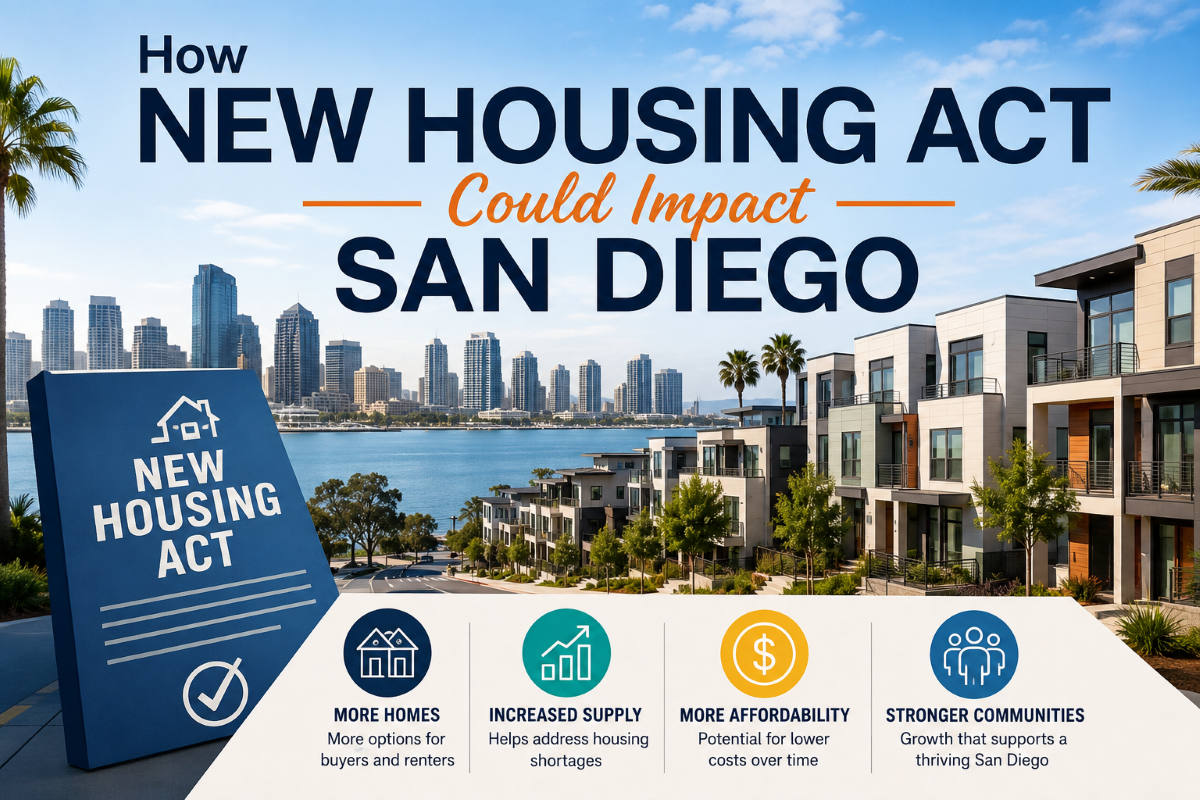
How New Housing Act Could Impact San Diego
The passage of the 21st Century ROAD to Housing Act represents the most significant shift in federal housing policy since at least 1990. Passed with sweeping bipartisan margins in late June 2026, the comprehensive housing package officially became law on July 11, 2026, after President Trump opted to neither sign nor veto it.
While initial coverage highlighted the law as a "grab bag" of 47 different provisions aimed at incrementally boosting national housing supply over the next few years, details from legislative documents and regional housing advocates reveal a multi-layered federal framework. For a high-demand, high-cost region like San Diego and the broader state of California, the law introduces changes specifically engineered to address local bottlenecks.
Here is an expanded, comprehensive breakdown of how the new law impacts California and San Diego, incorporating perspectives and technical details from the California Council for Affordable Housing, the House Financial Services Committee, and regional policymakers.
1. Infusing Capital Into Affordable Housing
Local housing advocates like Stephen Russell, President and CEO of the San Diego Housing Federation, have long pointed out that a classic supply-and-demand crisis has driven up the cost of even 30- to 40-year-old "naturally affordable" housing.To bridge the severe financing gaps that halt projects in California, the new law incorporates the Community Investment and Prosperity Act (spearheaded by Southern California Rep. Young Kim). This provision raises the Public Welfare Investment (PWI) cap for national and state member banks from 15% to 20%.
- The Impact: This regulatory tweak allows commercial banks to deploy billions of additional dollars directly into local community development and affordable housing equity, such as Low-Income Housing Tax Credit (LIHTC) developments.
2. Streamlining the Regulatory "Roadblocks"
While California has made strides in streamlining its own California Environmental Quality Act (CEQA) requirements for dense housing, developers frequently run into secondary delays waiting for federal reviews.
- NEPA Exemptions: The new act creates "categorical exclusions" under the National Environmental Policy Act (NEPA). It allows HUD to fast-track or entirely exempt small-scale infill, rehabilitation, and modest residential projects from lengthy environmental reviews if they don't materially alter the project's original footprint.
- Zoning Incentives: The law establishes a $200 million annual competitive grant program over the next five years. It awards financial bonuses to municipalities that voluntarily reform local zoning—such as reducing parking minimums, expanding "by-right" approvals for multi-unit properties (duplexes to quadruplexes), and adopting pre-reviewed architectural designs for accessory dwelling units (ADUs) and small townhomes. Conversely, cities that aggressively block housing supply could face minor reductions in their Community Development Block Grant (CDBG) funding.
3. Unleashing Factory-Built and Alternative Housing
Building traditional housing in San Diego is notoriously expensive due to land and labor costs. The law attempts to modernize how homes are built by revising the decades-old federal definition of a "manufactured home."
- Off-Chassis Construction: Previously, HUD regulations required manufactured homes to be built on a permanent chassis. The new law eliminates this barrier, placing modular and prefabricated homes built without a permanent chassis on equal footing for federal financing, titles, and installation. This gives California developers architectural flexibility to drop pre-fabricated, cost-effective infill units directly into dense urban neighborhoods.
- Commercial Conversions: Through the new RESIDE Act pilot program, the federal government is dedicating grants specifically to help cities convert empty commercial buildings, strip malls, and warehouses into mixed-income or "attainable" residential properties.
4. Direct Relief for Vulnerable San Diegans
The law goes beyond developers and investors to directly alter eligibility rules for individuals struggling to find housing in California:
- Excluding Veteran Disability Benefits: Crucially for San Diego's massive military and veteran population, the law includes a provision long championed by California Senator Alex Padilla. It permanently prohibits HUD from counting a veteran’s disability benefits as "income" when determining eligibility for the HUD-VASH (Veterans Affairs Supportive Housing) program. Previously, receiving disability compensation could paradoxically disqualify a homeless veteran from getting housing assistance.
- Preserving Public Housing: The law lifts the federal Rental Assistance Demonstration (RAD) cap by 100,000 units. Because California has one of the largest backlogs of aging public housing units in need of rehabilitation, this allows local housing authorities to shift properties to the Section 8 platform, leveraging private capital to repair buildings without displacing low-income residents.
- Wildfire and Disaster Recovery: For a state regularly hit by environmental crises, the permanent authorization of the CDBG-Disaster Recovery (CDBG-DR) program ensures that federal funds to rebuild destroyed affordable housing will be deployed predictably, skipping the typical congressional gridlock that occurs after major wildfires.
5. Restricting Large Corporate Landlords
A major inclusion pushed to stabilize neighborhoods—and address a growing grievance among middle-class California buyers—is the "Homes are for People, Not Corporations" provision.
- The Crackdown: The law places tight restrictions on large institutional investors (defined as corporations owning 350 or more single-family homes) from buying up starter homes.
- The Fine Print: Wall Street firms are largely barred from purchasing existing single-family properties unless they are participating in highly regulated "build-to-rent" or "renovate-to-rent" programs. Even then, they are legally required to sell those homes back to individual homebuyers after seven years or face civil penalties of up to $1 million per violation.
The Reality Check
Policy analysts and regional experts agree with the San Diego Housing Federation's timeline: relief will not be immediate. Because the law relies on a web of pilot programs, grant distributions, and updated HUD rule-making frameworks, the benefits will filter into the California market gradually. Most real estate and economic projections suggest it will take two to three years before San Diegans see a noticeable expansion in local project pipelines and housing availability.


